
Sleep is a Treasure Trove of Health Data: Why Overnight Vitals Monitoring Matters
Updated: Jun 30
Monitoring vital signs during sleep reveals hidden health signals that daytime checks often miss. Abnormal overnight patterns in heart rate, blood pressure, oxygen saturation (SpO₂), respiration, and other vitals can flag serious conditions such as sleep apnea, nocturnal hypertension, arrhythmias, COPD and heart failure, thereby predicting outcomes. This blog is a deep dive into key overnight vitals and why they matter, health conditions revealed by overnight data, evidence and interpretation, as well as practical recommendations for clinicians, device developers, and consumers on using overnight vital data to improve health.
Sleep is the sole prolonged stretch of the day when the body is largely undisturbed by external noise such as movement, stress, posture shifts, and environmental stimuli. This makes it an unusually clean window for physiological measurement. Daytime readings are frequently shaped by activity and context, whereas overnight data shows how the body regulates itself at baseline. For wearables, this creates an opportunity to observe deeper health signals that are otherwise difficult to detect in short, fragmented measurements.
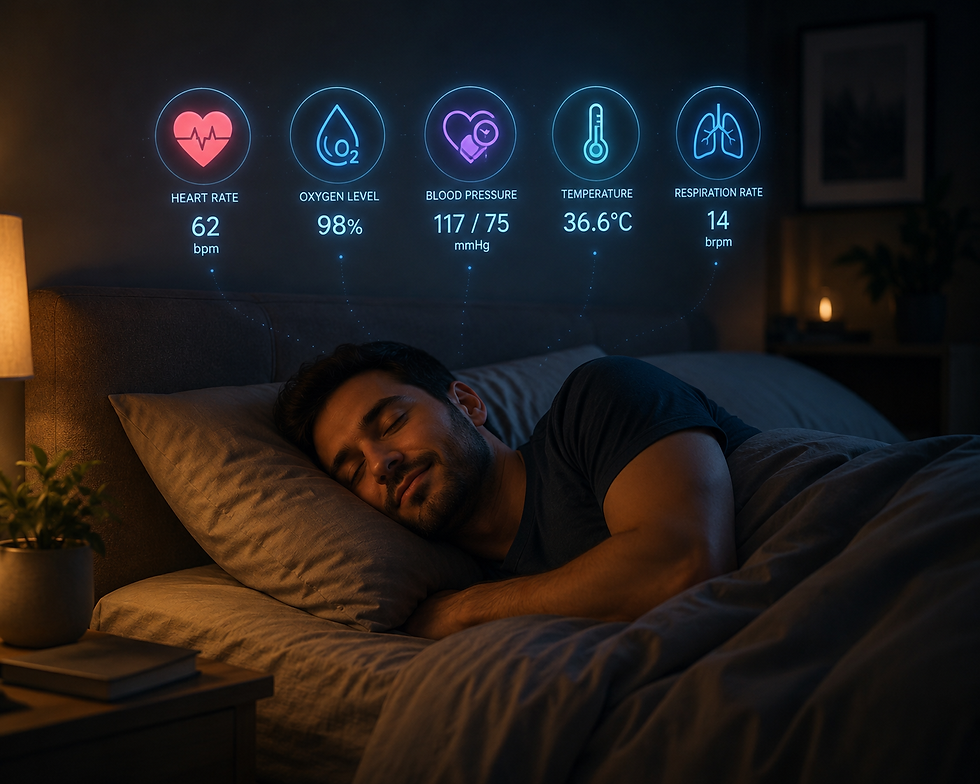
Why Sleep is Uniquely Informative
Sleep provides a baseline-controlled, low-activity window where the body’s essential regulatory systems unfold in predictable patterns. During this time, several important physiological changes occur in a structured way. The autonomic nervous system shifts, causing heart rate and blood pressure to dip during non-REM sleep and rise again during REM sleep and the early morning hours. Abnormalities in these patterns, particularly non-dipping or “reverse dipping” BP, are strongly linked to higher cardiovascular risk.¹
Breathing also changes during sleep. In healthy individuals, respiration slows and airway muscles relax, leading to only minor drops in oxygen saturation (SpO₂). However, in conditions like sleep apnea, repeated pauses in breathing (apneas or hypopneas) can cause significant oxygen desaturation, placing stress on the body.
At the same time, the body undergoes critical metabolic and restorative processes. Hormonal regulation, tissue repair, and inflammatory responses are all active during sleep, meaning that abnormalities in these processes can signal underlying systemic stress or disease.
In short, night time acts as a natural “stress test” for the body’s internal balance, or homeostasis. Simply put, homeostasis is the body’s ability to maintain stable internal conditions, like temperature, blood pressure, and oxygen levels, despite external changes. Sleep reveals how well this balance is maintained without interference from daily activity.
This is also why many serious health events tend to cluster around sleep-wake transitions. Heart attacks and sudden cardiac death, for instance, are more common in the early morning hours.² Sleep offers valuable insights into conditions like hypertension, diabetes, cardiovascular disease and other hidden conditions that may simply not be apparent during the day.
Key Overnight Vital Signs and Their Importance
Not all vitals are equally informative at night. Here are the main ones to watch:
Vital Sign | Why it Matters (Sleep Context) | Normal Range During Sleep | Monitoring Method |
Heart rate | Expected to slow in deep sleep. Elevated overnight heart rate or lack of slowdown signals stress (e.g. hyperthyroidism, fever) or deconditioning. Sudden arrhythmias (PVCs, pauses) can indicate OSA or heart disease. | ~40-60 bpm in healthy adults (varies by age/fitness). Occasional fluctuations normal. | Wearables: PPG-based heart rate (smartwatch, ring); chest ECG or Holter (clinical gold standard). |
Heart rate variability (HRV) | High overnight HRV is normal (high parasympathetic tone). Low HRV during sleep can indicate autonomic dysfunction or stress, and may precede hypertension or insulin resistance. | No fixed “normal” value; generally higher is better. Comparisons made to personal baseline. | Derived from inter-beat intervals via ECG or PPG. Some wearables report HRV indices (RMSSD, HF-power). |
Blood oxygen (SpO₂) | Continuous oxygenation during sleep ensures tissue health. Drops below 90% (desaturations) suggest sleep apnea or lung disease. The frequency and depth of dips (hypoxic burden) strongly predict cardiovascular disease risk. | ≥96% while supine awake; may dip into 90-95% briefly. Sustained <90% (or repeated 4%+ drops) is abnormal.³ | Wearable pulse oximeters (finger or wrist, e.g. smart rings, watch sensor) and medical-grade oximeters (finger probe) used overnight. Polysomnography and overnight oximetry tests (clinic/home) provide reference. |
Respiratory rate (RR) | Reflects ventilatory control. Normal RR drops modestly in sleep. Increases or irregular patterns (periodic breathing) occur in congestive heart failure or central sleep apnea. | ~12–16 breaths/min in adults; can vary with sleep stage. | Monitored via chest belts (thoracic/ abdominal effort), capnography, or inferred by wearables (some smart rings/ watches). |
Blood Pressure (BP) | Nighttime “dipping” is normal; failure to dip (or “reverse dip” rise) signals high cardiovascular disease risk. Nocturnal hypertension often goes undetected in clinic checks. | Typically ~10–20% lower than daytime. Night BP ≥120/70 mmHg defines hypertension. | 24-hr ABPM (cuff-based) is clinical gold standard. Emerging cuffless wearables (e.g. wrist PPG to BP) and waking-office BP not adequate for night. |
Core/ Peripheral Temperature | Body cooling at night is normal (facilitates sleep). Elevated overnight temperature (fever) or excessive drops can be signs of illness or dysregulation. | Slight drop of ~0.5-1°F around early morning. | Clinical infrared thermometers (single checks) or wearable/ nearable skin sensors track night temperature trends. |
In specialized settings, overnight monitoring may include EEG (sleep stage), ECG (for arrhythmias), or even CGM glucose. For our purposes, the vital signs above (HR, BP, SpO₂, RR, temperature) are the most relevant for home or wearable devices.
Health Conditions and Outcomes Revealed by Overnight Monitoring
Many chronic conditions either emerge or worsen during sleep, making overnight vital sign monitoring a powerful tool for early detection and risk prediction. In obstructive sleep apnea (OSA), repeated airway collapse leads to intermittent drops in oxygen levels, spikes in heart rate and blood pressure, and fragmented sleep. While clinically significant OSA affects up to half of middle-aged adults, most moderate-to-severe cases remain undiagnosed. Overnight data not only identifies apneas but also reveals deeper risk patterns, such as hypoxic burden, which has been shown to predict complications and cardiovascular outcomes more strongly than traditional indices like AHI.⁴ Chronic intermittent hypoxia is also linked to future hypertension, atrial fibrillation, stroke, and diabetes.
Blood pressure behaves differently at night, and this variation carries important prognostic value. Individuals with “non-dipping” or elevated nighttime blood pressure face significantly higher risks of stroke and heart disease, even if their daytime readings are normal. Large cohort studies have shown that nocturnal blood pressure is often a better predictor of cardiovascular events than clinic measurements, and newer findings suggest that current methods may even underestimate the true burden of nocturnal hypertension.
Cardiac rhythm abnormalities are also frequently unmasked during sleep. While some slow heart rhythms in deep sleep are benign, others such as atrial fibrillation, ventricular ectopy, or conduction blocks can signal underlying disease. Certain dangerous arrhythmias are more likely to occur at night, and population data shows that sudden cardiac death peaks in the early morning hours, coinciding with sleep-stage transitions and hormonal surges. Detecting these patterns through overnight monitoring can provide critical insight into cardiovascular risk.
Respiratory conditions like chronic obstructive pulmonary disease (COPD) and interstitial lung disease often appear stable during the day but worsen at night, when oxygen levels can drop significantly due to reduced respiratory drive. Prolonged nocturnal desaturation is common in these patients and may indicate the need for early intervention such as oxygen therapy or ventilatory support. Similarly, in heart failure, abnormal breathing patterns like Cheyne–Stokes respiration create cyclical fluctuations in oxygen levels and are associated with worse prognosis and higher arrhythmia risk.
Beyond individual diseases, broader patterns in overnight physiology also carry meaning. Poor sleep quality, reflected in frequent arousals or sustained autonomic activation, has been linked to hypertension, insulin resistance, and overall cardiometabolic risk. Even subtle disruptions, such as abnormal temperature regulation or nocturnal hypoglycemia, may point to underlying metabolic or endocrine disorders.
Taken together, overnight abnormalities act as an early warning system for a wide range of conditions. The clinical importance lies not just in isolated events, but in patterns observed across the entire night and over multiple nights. Continuous overnight monitoring provides a more complete picture of cardiovascular and respiratory health, enabling earlier detection, better risk stratification, and more informed clinical decisions.
Wearables vs. Clinical Overnight Monitoring
Wearable devices and clinical overnight monitoring serve similar purposes but differ significantly in accuracy, convenience, and use. Traditional clinical methods like polysomnography, ambulatory blood pressure monitoring (ABPM), and medical-grade oximeters remain the gold standard because they provide highly accurate, continuous measurements of parameters such as brain activity, heart function, breathing, blood pressure, and oxygen levels. However, these methods are expensive, often uncomfortable, and typically limited to short-term use in controlled settings, making them impractical for routine or long-term monitoring in everyday life.
In contrast, wearables such as smartwatches, rings, and sensor-based systems allow continuous, at-home tracking of metrics like heart rate, oxygen saturation, sleep patterns, and sometimes temperature or respiratory rate. They are far more convenient and scalable, and studies show they can be reasonably accurate for tracking trends over time, especially for resting heart rate and sleep-related patterns. That said, their accuracy can vary due to factors like movement, improper fit, or sensor limitations, and most cannot directly measure key clinical signals like blood pressure, airflow, or brain activity. Additionally, many consumer wearables are not clinically validated and are intended for general wellness rather than medical diagnosis.
As a result, a hybrid approach is becoming more common. Wearables are increasingly used to monitor long-term trends and flag potential issues, while clinical tests are reserved for confirming diagnoses and guiding treatment decisions.
Overall, wearable devices extend monitoring to the 23 hours outside of the clinic. But their data must be interpreted with caution.
Interpreting Overnight Data: Trends, Baselines & Circadian Context
Collecting data is only half the battle. Making sense of it is most crucial. Key principles to interpretation of this data include:
Trends over Spikes: An isolated aberration (one low SpO₂, one high HR) often isn’t meaningful. What matters is the pattern over hours or days. For example, one night with a few oxygen dips might be due to temporary nasal congestion; but a nightly pattern of repeated dips is likely pathological. Similarly, BP should be averaged. 24-hour ABPM defines nocturnal hypertension by the mean sleep BP, not a single reading.
Relative Baselines: Each person’s “normal” is shaped by age, fitness, and chronic conditions. A heart rate of 60 in one person might be bradycardia in another. Wearable apps increasingly compare values to the user’s own history. For example, a consistent shift in a user’s normal sleep HR or SpO₂ baseline could trigger review, rather than fixed population thresholds.
Sleep Stages: Vitals naturally vary by sleep stage. REM sleep, for instance, can cause brief sympathetic surges (higher HR/BP, more variable breathing) whereas deep NREM sleep is the most quiescent. Thus, one must consider when during the night, i.e. what stage of sleep, an abnormality occurs.
Holistic Signs: Data should be correlated with symptoms and context. If a patient has daytime sleepiness or loud snoring, that heightens the suspicion of OSA. Multiple moderate changes such as slightly elevated heart rate, mild oxygen drops and slight arrhythmia, together tell more than each alone.
Circadian context is crucial. Our biological clocks regulate everything from cortisol release to kidney function, so some variation is normal. Clinicians often look at percent change from daytime. For example, HRV being lower at night is expected, but progressively lower HRV across successive nights might indicate accumulating stress or illness.
In summary, good overnight monitoring programs analyze data in aggregate, look for sustained or repeated deviations from personal norms, and flag them relative to normal sleep physiology and circadian rhythms.
Overnight Data: Practical Recommendations
For Clinicians and Care Teams
Screen High-Risk Patients: Use overnight monitoring (sleep study, oximetry, ABPM) for patients with resistant hypertension, unexplained arrhythmias, heart failure, stroke, or classic OSA symptoms. Even in general practice, a good sleep history and at-home oximetry can uncover undiagnosed OSA/COPD.
Monitor Trends, Not One-off Values: When reviewing overnight data from devices or patient logs, focus on averages and repeated events. For example, look at average night BP or total number of SpO₂ dips per hour rather than a single lowest value.
Combine Data Sources: Use wearables to complement, not replace, clinical monitors. Use a smart band’s nightly HR and SpO₂ trends to decide if a patient should get a formal sleep study or ABPM. If a wearable frequently flags possible atrial fibrillation at night, arrange a Holter monitor.
Educate Patients: Encourage patients to get at least 7 hours of sleep (CDC recommendation)⁵ and avoid driving or operating heavy machinery if they have sleep fragmentation. Explain which vitals are being monitored and what the target ranges are (e.g. “We expect your SpO₂ to stay above 90% most of the night”).
Privacy Best Practices: Ensure that any remote monitoring platform you use is HIPAA-compliant. Advise patients to review app permissions: they should know if their sleep data is shared with third parties. Consider institutional policies for approving patient-supplied data devices.
For Product Teams (Wearables and Apps)
Validate Against Sleep Labs: Whenever possible, validate your vitals measurements during sleep against PSG or clinically approved devices. Disclose accuracy metrics.
User-Centered Alerts: Use gentle, actionable language. Instead of alarm tones, use a “check your data” prompt. Provide context: e.g. “Your average sleep HR was 5% higher than your baseline; if this persists, consider hydration or stress reduction.”
Customization: Allow users (or clinicians) to set personalized thresholds. For instance, a known asthmatic patient might set a lower SpO₂ alert threshold than a healthy user.
Data Security: Implement encryption at rest and in transit. Minimize third-party sharing. Obtain explicit consent for any data use beyond core functionality. Consider on-device processing for sensitive metrics (to avoid sending raw data to servers).
Clinical Integration: Build interoperability features (e.g. export to EHR, standard APIs) and dashboards for clinicians. Offer summary reports (e.g. weekly trends) rather than raw nightly logs.
For Consumers and Patients
Use Trends, Not Instant Checks: Check your device data once a day (e.g. in the morning), not every few minutes, to avoid anxiety. Focus on weekly trends (e.g. “My average sleep HR was gradually rising, I should see my doctor”) rather than individual nights.
Correlate with Symptoms: Don’t ignore how you feel. If your tracker says you had a poor “sleep score” but you feel fine and refreshed, one bad night might not be worrisome. Conversely, if you often wake unrefreshed or snore heavily, consider an evaluation even if your wearable hasn’t flagged an issue.
Enable Only Useful Alerts: Turn off non-critical notifications (e.g. every single REM/Wake classification). Keep alerts for things like dangerously low SpO₂ (if your device supports it).
Privacy Awareness: Review the privacy policy of your sleep device/app. Prefer apps that state they do not sell your health data. Use strong passwords and keep firmware up to date.
Conclusion
Sleep is a rich window into health. By continuously monitoring vitals overnight, we catch signals hidden in daytime: nocturnal hypertension, sleep apnea hypoxia, occult arrhythmias, early COPD desaturations, and more. These findings are not just academic. They have real impact. Studies show that addressing sleep-disordered breathing and night time high BP can reduce heart attacks and strokes. Yet most of this data is currently wasted unless we actively measure it.
In the coming years, advances in wearables and AI promise to make overnight monitoring routine. But even today, clinicians and patients can harness these insights by combining smart sensors with clinical knowledge. The key is contextual interpretation: understanding what a night’s worth of data means for the individual patient. With careful design, wearables can be tools of empowerment, alerting users at just the right time to seek help. Used properly, they turn what was once obscured in the night into actionable health information.
After all, a single good night’s data could mean many good nights ahead.
References:
Tomitani, N. (2025, February 3). Challenges in monitoring nighttime blood pressure. Nature News. https://www.nature.com/articles/s41440-025-02132-z?error=cookies_not_supported&code=5b206dee-533b-4ceb-a5e1-977d11452d7b#:~:text=In%20addition%20to%20nighttime%20BP,reproducibility%20of%20nighttime%20BP%20dipping
Gula, L. J., Krahn, A. D., Skanes, A. C., Yee, R., & Klein, G. J. (2004). Clinical relevance of arrhythmias during sleep: Guidance for clinicians. Heart, 90(3), 347–352. https://doi.org/10.1136/hrt.2003.019323
What are normal oxygen levels during sleep?. Superpower. (n.d.). https://superpower.com/guides/what-are-normal-oxygen-levels-during-sleep?srsltid=AfmBOop8aRV8mY7eR6nxnI7wqmcS0yv6CB8uHsRbssa20rnTl7xTI4zM#:~:text=The%20clinical%20threshold%20for%20concern,apnea%20severity%20and%20cardiovascular%20risk
Yeghiazarians, Y., Jneid, H., Tietjens, J. R., Redline, S., Brown, D. L., El-Sherif, N., Mehra, R., Bozkurt, B., Ndumele, C. E., & Somers, V. K. (2021). Obstructive sleep apnea and cardiovascular disease: A scientific statement from the American Heart Association. Circulation, 144(3). https://doi.org/10.1161/cir.0000000000000988
Centers for Disease Control and Prevention. (n.d.). About sleep. Centers for Disease Control and Prevention. https://www.cdc.gov/sleep/about/index.html


Comments