
Injection Moulding in Wearable Product Development: Engineering Plastic Components for Performance, Precision, and Scale
Injection moulding is the manufacturing process that enables wearable devices to be produced with high precision, consistent quality, and low cost at scale. From smart rings and smartwatches to fitness bands and medical wearables, it allows manufacturers to create lightweight, durable, and complex plastic components with tight tolerances and excellent surface finishes. This article explains how injection moulding works in wearable product development, why it is essential for mass production, the engineering challenges involved, and how thoughtful mould and part design directly impact product performance, reliability, and manufacturability.
Introduction
The rapid evolution of health wearables has transformed the way people monitor their well-being, enabling continuous tracking of vital parameters such as heart rate, blood oxygen saturation (SpO₂), ECG, skin temperature, and activity levels. As these devices become increasingly compact, lightweight, and feature-rich, the demands on their mechanical design continue to grow. While advancements in electronics and sensing technologies often take center stage, the plastic enclosure that houses these components is equally critical in ensuring product reliability, comfort, and long-term performance.
Injection moulding has emerged as the manufacturing process of choice for producing wearable enclosures due to its ability to create complex, high-precision components with exceptional repeatability and efficiency. However, designing an injection-moulded part for a health wearable extends far beyond creating a visually appealing plastic shell. Engineers must carefully consider material selection, wall thickness, structural reinforcement, tolerance control, sensor integration, sealing strategies, and manufacturability — all within the limited space available in compact devices such as smart rings, fitness bands, and medical monitoring wearables.
What is Injection Moulding and How Does It Work?
Injection moulding is a manufacturing process used to produce plastic components by injecting molten polymer into a precision-engineered mould cavity. It is widely used across industries due to its ability to manufacture parts with high dimensional accuracy, excellent surface finish, and consistent quality at scale.
The process begins with plastic pellets being fed into a heated barrel where they are melted by a rotating screw. The molten material is then injected under high pressure into a mould cavity that defines the geometry of the final component. After filling, the material is allowed to cool and solidify before the mould opens and ejector pins release the finished part. The cycle then repeats, enabling thousands or even millions of identical components to be produced efficiently.

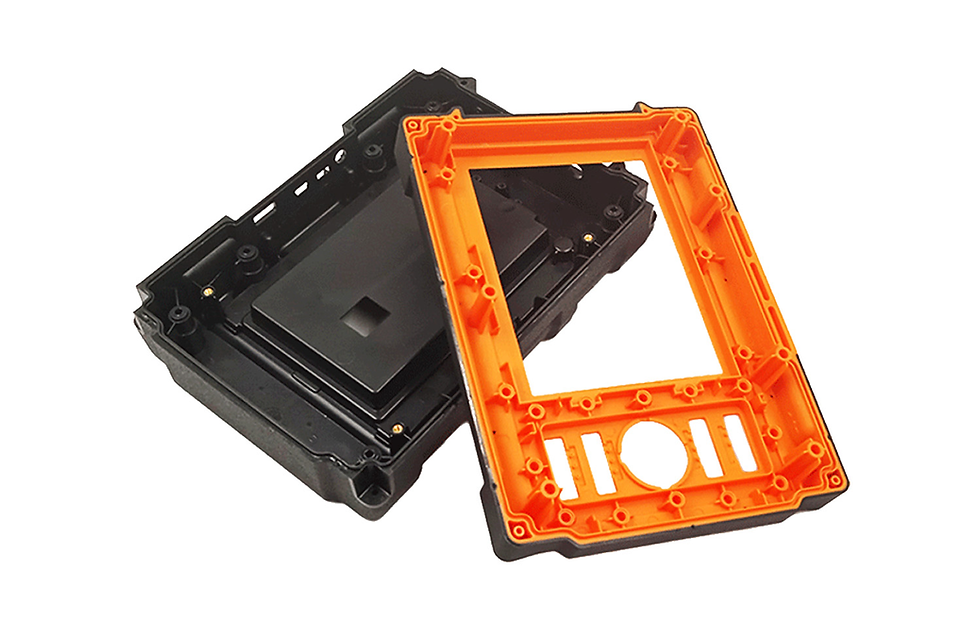
For health wearables, injection moulding is used to manufacture enclosures, battery covers, sensor housings, charging interfaces, strap components, and internal mounting structures. The ability to produce lightweight yet durable components with tight tolerances makes injection moulding an indispensable technology in wearable product development.
Why Injection Moulding is Critical for Health Wearables
Health wearables present unique design challenges. Unlike traditional electronic devices, they remain in constant contact with the human body and are expected to operate reliably under a variety of environmental conditions. They must be comfortable to wear, resistant to sweat and moisture, durable enough to withstand daily use, and capable of maintaining sensor accuracy throughout their lifecycle.
Injection moulding provides the flexibility needed to meet these requirements. Complex geometries can be manufactured with integrated features such as sensor alignment structures, battery retention mechanisms, gasket grooves, snap-fits, and PCB mounting bosses. These features reduce assembly complexity while improving product reliability.
Furthermore, the high repeatability of injection moulding ensures that every component performs consistently. This is particularly important for wearable devices where small dimensional variations can affect sensor positioning, waterproofing performance, and assembly quality.
Material Selection for Wearable Applications
Material selection is a critical aspect of injection-moulded wearable product development, as it directly influences the device's performance, durability, user comfort, and manufacturability. Unlike conventional consumer products, health wearables are continuously exposed to sweat, body heat, UV radiation, moisture, accidental impacts, and repeated handling. The enclosure material must therefore provide an optimal balance of mechanical strength, dimensional stability, chemical resistance, and aesthetic quality while supporting high-volume manufacturing processes.
Among the most commonly used engineering plastics, Polycarbonate (PC) is valued for its excellent impact resistance, high dimensional stability, and optical transparency, making it an ideal choice for optical sensor windows and protective covers. Acrylonitrile Butadiene Styrene (ABS) offers good rigidity, surface finish, and ease of processing, while PC-ABS blends combine the toughness of polycarbonate with the superior mouldability of ABS, making them widely used for smartwatch and fitness band enclosures.
For components requiring flexibility, Thermoplastic Polyurethane (TPU) is commonly selected due to its elasticity, abrasion resistance, and comfortable feel, making it ideal for wearable straps and overmoulded features. Medical-grade Liquid Silicone Rubber (LSR) is frequently used for skin-contact components because of its biocompatibility, flexibility, and resistance to environmental degradation.
Selecting the appropriate material also requires consideration of injection moulding characteristics such as shrinkage, flow behaviour, cooling rate, and mouldability. By aligning material properties with both product requirements and manufacturing constraints, engineers can achieve durable, lightweight, and reliable wearable devices that consistently meet functional, regulatory, and aesthetic expectations.

Designing Plastic Parts for Manufacturability
The success of an injection-moulded component is determined long before the first part is produced. Effective plastic part design is fundamental to achieving consistent product quality, minimizing manufacturing defects, and reducing tooling and production costs. In health wearable devices, where compact packaging, intricate geometries, and tight dimensional tolerances are essential, every design feature must be optimized for manufacturability while meeting functional and aesthetic requirements.
One of the most important considerations is maintaining a uniform wall thickness throughout the component. Variations in wall thickness can lead to uneven cooling, causing defects such as sink marks, warpage, voids, and internal stresses that compromise dimensional stability. For wearable products, this is particularly critical around battery compartments, sensor cavities, and sealing interfaces, where even minor deformations can affect assembly accuracy and overall product performance.
Another key design principle is the incorporation of appropriate draft angles on vertical surfaces. Draft allows the moulded part to be ejected smoothly from the tool without damaging cosmetic surfaces or delicate features. Since wearable devices often feature curved profiles and premium surface finishes, optimizing draft angles is essential to preserve both appearance and dimensional accuracy.
Structural features such as ribs and bosses further enhance the functionality of injection-moulded parts. Ribs increase stiffness and improve load distribution without significantly increasing material usage, while bosses provide secure mounting points for screws, inserts, and printed circuit boards. When designed with appropriate dimensions and fillets, these features improve structural integrity, simplify assembly, and reduce the likelihood of moulding defects. By incorporating these Design for Manufacturing (DFM) principles early in the product development process, engineers can produce wearable components that are robust, manufacturable, and capable of supporting high-volume production with consistent quality.
Snap-Fit Design: Enabling Efficient Assembly in Health Wearables
As wearable devices continue to become smaller and more compact, reducing the number of individual components has become an important design objective. Snap-fits have therefore become one of the most widely adopted assembly methods in injection-moulded wearable products. Unlike traditional fastening methods such as screws or adhesives, snap-fits are moulded directly into the enclosure, allowing components to be assembled quickly while reducing part count, manufacturing cost, and assembly time.
In health wearables, snap-fits are commonly used to join enclosure halves, secure battery covers, retain internal PCBs, and position charging modules. Their ability to provide repeatable assembly without additional hardware makes them particularly suitable for high-volume manufacturing. However, because snap-fits rely on the elastic deformation of the plastic material during assembly, the design must account for the mechanical properties of the selected polymer, expected loading conditions, and product life cycle.
Poorly designed snap-fits are a common source of manufacturing and field failures. Excessive interference between mating components can lead to high assembly forces, increasing the risk of cracking or permanent deformation during installation. Sharp internal corners often act as stress concentrators, accelerating fatigue failure after repeated assembly cycles. Similarly, inadequate clearance or dimensional variations caused by material shrinkage can result in loose engagement, rattling, or incomplete locking of enclosure components.
From an injection moulding perspective, the location and geometry of snap-fits should also be considered during tooling design. Improper gate placement may create weld lines at highly stressed regions, reducing mechanical strength, while poor cooling can lead to localized warpage that affects alignment between mating parts. These challenges highlight the importance of integrating snap-fit design with mould flow analysis and Design for Manufacturing (DFM) principles early in the product development process.
By combining sound mechanical design with optimized injection moulding practices, engineers can develop snap-fit features that provide reliable assembly, maintain enclosure integrity, and support efficient high-volume production throughout the product's lifecycle.
Waterproofing and Environmental Protection
Health wearables are designed to operate reliably in a wide range of everyday environments, including exposure to sweat, rain, dust, handwashing, and, in some cases, prolonged water immersion. Protecting sensitive electronic components from moisture and contaminants is therefore a fundamental aspect of wearable product design. A robust waterproofing strategy not only enhances product reliability but also extends the operational lifespan of the device while maintaining user confidence.
Injection moulding plays a crucial role in achieving effective environmental protection by enabling the precise manufacture of sealing features directly into the enclosure. Components such as gasket grooves, O-ring interfaces, ultrasonic welding joints, adhesive bonding surfaces, and overmoulded seals can be accurately integrated into the design to create reliable barriers against water ingress. The dimensional consistency offered by injection moulding ensures that these sealing features perform consistently across high-volume production.
Achieving ingress protection ratings such as IP67 or IP68 requires more than simply adding a gasket. Engineers must carefully consider material selection, mould shrinkage, tolerance stack-up, surface flatness, and assembly methods to ensure uniform compression of the sealing elements. Even slight dimensional deviations caused by poor tooling or inconsistent processing can compromise the integrity of the seal, leading to moisture ingress and potential product failure. By incorporating Design for Manufacturing (DFM) principles and validating sealing performance early in the development cycle, manufacturers can produce durable, waterproof wearable devices that meet both functional and regulatory requirements while ensuring long-term reliability.
Common Injection Moulding Defects in Wearable Products
Achieving consistent quality in injection-moulded wearable components requires careful attention to both part design and process parameters. Even with advanced moulding technologies, defects can arise if factors such as material selection, wall thickness, cooling, or tooling design are not properly optimized. Since health wearables rely on compact assemblies, tight tolerances, and premium surface finishes, even minor defects can impact functionality, aesthetics, and product reliability.
One of the most common defects is sink marks, which appear as shallow surface depressions caused by localized material shrinkage in thicker sections. They are typically found near ribs, bosses, or mounting features and can compromise both the cosmetic appearance and dimensional accuracy of the enclosure. Warpage occurs due to uneven cooling or non-uniform shrinkage, causing parts to deform after ejection. In wearable devices, warpage can affect sealing surfaces, assembly fit, and the alignment of internal components.
Weld lines form when two or more molten plastic flow fronts meet during filling. Although often visible as fine lines on the surface, they can also create localized weak points, reducing the structural strength of the component. Another common issue is flash, where excess plastic escapes through the parting line or gaps in the mould, resulting in thin unwanted material that often requires secondary trimming.
Understanding these defects during the design and tooling stages enables engineers to optimize part geometry, material flow, and mould design. By applying Design for Manufacturing (DFM) principles and validating designs through simulation, manufacturers can minimize defects, improve production yields, and ensure consistent quality in high-volume wearable manufacturing.
Conclusion
Injection moulding is far more than a manufacturing process — it is a key enabler of innovation in modern health wearable devices. From material selection and component geometry to snap-fit design, waterproofing, and defect prevention, every stage of the injection moulding process directly influences the performance, reliability, and manufacturability of the final product. As wearable devices continue to become smaller, lighter, and more functionally advanced, engineers must adopt a holistic design approach that considers both product functionality and manufacturing feasibility. Integrating Design for Manufacturing (DFM) principles early in the development cycle helps reduce tooling iterations, improve production yields, minimize assembly challenges, and ensure consistent product quality across high-volume manufacturing.
The success of a wearable product depends not only on its electronics and sensing capabilities but also on the precision and robustness of the mechanical components that protect and support them. Well-designed injection-moulded parts enhance structural integrity, improve environmental protection, simplify assembly, and contribute significantly to the overall user experience. By combining sound mechanical engineering practices with optimized tooling, material selection, and process control, manufacturers can develop products that are reliable, scalable, and ready for mass production. As the demand for next-generation health wearables continues to grow, injection moulding will remain a cornerstone of product development, enabling the creation of compact, durable, and high-quality devices that meet the evolving expectations of both manufacturers and end users.


Comments